Desert subterranean termites (Heterotermes aureus) are an endemic biological reality of the Sonoran Desert in Maricopa County. Unlike subterranean species in temperate climates that nest shallowly, desert subterranean…
Desert subterranean termites (Heterotermes aureus) are an endemic biological reality of the Sonoran Desert in Maricopa County. Unlike subterranean species in temperate climates that nest shallowly, desert subterranean termites withstand arid soil conditions and forage at depths exceeding 8 feet below the surface. They exploit microscopic expansion joints, plumbing penetrations, and foundation settlement cracks to enter wall voids. In historic neighborhoods like the Willo Historic District or Encanto Village, older stem-wall and raised foundations frequently present unsealed entry points along subfloor sill plates. Conversely, post-tension slab homes built across Desert Ridge, Ahwatukee Foothills, and North Mountain Village seal exterior wood from the dirt, but termites bypass the slab by constructing vertical shelter tubes (mud tubes) over concrete footers or through interior bath traps hidden beneath bathtubs and utility rooms.
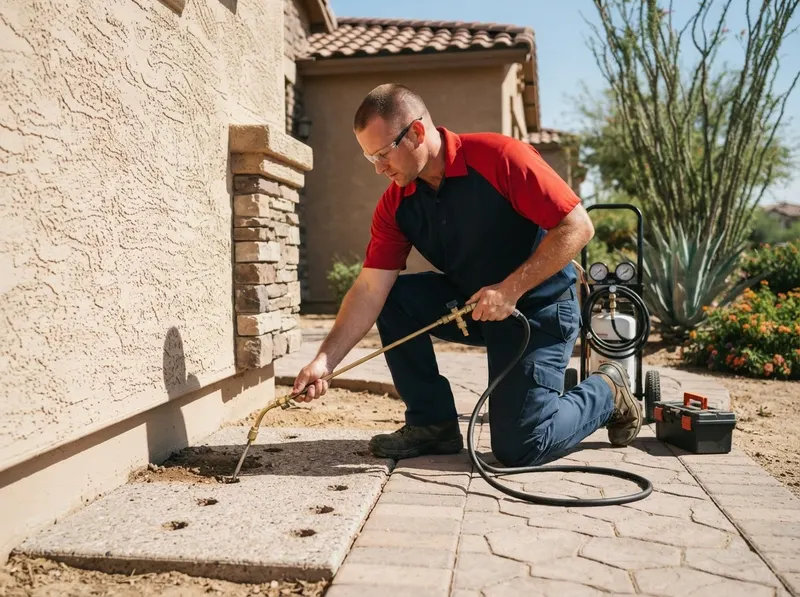
Subterranean termite treatment requires establishing an uninterrupted chemical barrier through trenching exterior soil and precision drilling hard surfaces. Trenching entails digging a 6-inch-wide by 6-inch-deep trench directly against the foundation perimeter and saturating the soil with 4 gallons of finished non-repellent termiticide per 10 linear feet. Where flatwork abuts the home, such as covered patios, aggregate pool decks, and garages in Arcadia and the Biltmore Area, technicians drill 0.5-inch holes spaced 12 inches apart through the concrete to inject termiticide directly into the gravel bedding below. Modern non-repellent formulas (such as fipronil) do not trigger pest avoidance behavior; foraging worker termites pass through the treated zone undetected, transferring the active ingredient back to the subterranean reproductive queen via grooming and mutual feeding (trophallaxis).
Homeowners weighing subterranean termite treatment must distinguish between liquid termiticide perimeter barriers and localized baiting stations. A baiting system uses exterior ground-monitoring stations that rely on random termite foraging to intercept plastic wood-composite baits over several months. While baiting avoids drilling interior tile or stamped patio concrete, it provides zero immediate barrier during peak monsoon flight seasons when swarming alates aggressively colonize framing. Liquid soil treatments provide an immediate, lethal boundary that halts wood consumption within 10 to 90 days of placement. Liquid barriers also resist thermal breakdown in sustained 115-degree Arizona summer soil temperatures, maintaining structural integrity across expansive native clay soils without requiring monthly cartridge-replacement subscriptions.
Treatment execution follows four sequential mechanical stages: (1) An inspector measures the exterior perimeter linear footage and maps plumbing penetrations using an acoustic or moisture detection meter. (2) Technicians excavate continuous trenches in all native dirt beds, avoiding irrigation drip lines. (3) Concrete walkways and carports are drilled using low-impact rotary hammer drills to deliver pressurized sub-slab injection, followed by color-matched mortar patching. (4) The exterior backfill is mixed with active termiticide and sealed against rain erosion.
Every job gets a firm, written price after a free on-site visit.
Tell us about your subterranean termite treatment job in Phoenix and we'll send a clear, written quote, usually the same day.
 Blue Barrel Pest Control