Africanized honey bees (*Apis mellifera scutellata* hybrids) and native paper wasps react quickly to ambient ground vibrations and high thermal conditions throughout Maricopa County. Between May and October, ambient…
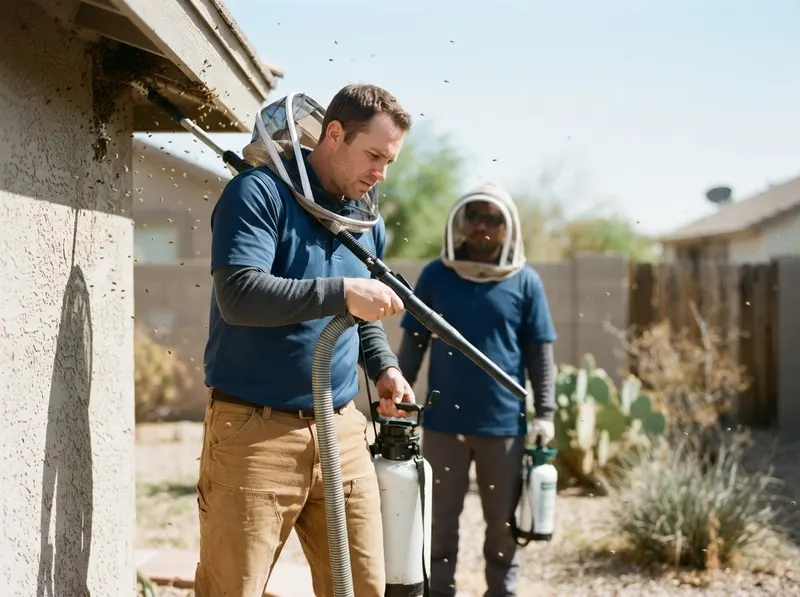
Africanized honey bees (*Apis mellifera scutellata* hybrids) and native paper wasps react quickly to ambient ground vibrations and high thermal conditions throughout Maricopa County. Between May and October, ambient temperatures exceeding 105 degrees Fahrenheit drive feral bee colonies into sheltered residential structures across neighborhoods like Arcadia, Ahwatukee Foothills, and the Biltmore Area. These hybrid colonies establish active nests inside irrigation boxes, weep screeds, attic soffits, and dense desert landscaping adjacent to Camelback Mountain and South Mountain Park and Preserve. Unlike European honey bees, Africanized colonies defend nests within a 50-to-100-foot perimeter and pursue perceived threats for up to 400 yards, creating severe puncture hazards for children, pets, and outdoor maintenance workers.
Professional extraction addresses the specific trade-off between exterior knockdown treatments and structural honeycomb cuts. While surface spray eliminates active adult wasps nesting beneath clay tile roof eaves in Desert Ridge or Encanto Village, established bee colonies leave behind tens of pounds of wax, raw honey, and brood comb. Leaving comb inside an attic or exterior block wall causes structural contamination, attracts carpet beetles and rodents, and melts into drywall when summer attic temperatures surpass 140 degrees Fahrenheit. For hollow block walls and sub-roof cavities in Willo Historic District or Maryvale homes, the service requires pinpoint localization using thermal acoustic checks, targeted vacuum or product application, and complete comb removal followed by structural proofing using galvanized 1/8-inch wire mesh.
Preventative perimeter defense isolates entry points before monsoon humidity shifts cause seasonal feral swarming across North Mountain Village and the Phoenix Mountains Preserve corridor. Structural exclusion seals utility penetrations, uncapped fence posts, and plumbing vents to deny secondary scouts access to interior wall voids. Residual barrier products formulated for extreme desert heat resist rapid UV breakdown along high-exposure stucco and brick surfaces, maintaining a sterile perimeter that deters re-colonization.
Every job gets a firm, written price after a free on-site visit.
Tell us about your africanized bee and desert wasp removal job in Phoenix and we'll send a clear, written quote, usually the same day.
 Blue Barrel Pest Control